Spirituality and Stoicism
What is Stoicism?
"Stoicism is an ancient Greek and then Roman philosophy of the Hellenistic and Roman Imperial periods.[1] The Stoics believed that the universe operated according to reason, or logos,[2] providing a unified account of the world, constructed from ideals of rational discourse, monistic physics, and naturalistic ethics.[3] These three ideals constitute virtue, which is necessary for the Stoic goal of 'living a well-reasoned life'."[4]
"Stoic logic focuses on highly intentional reasoning through propositions, arguments, and the differentiation between truth and falsehood. Philosophical discourse is paramount in Stoicism, including the view that the mind is in rational dialogue with itself.[4] Stoic ethics centers on virtue as the highest good, cultivating emotional self-control, a calm problem-solving state of mind, and rational judgment to attain lifelong flourishing (eudaimonia). At the same time, passions, anxieties, and insecurities are viewed as misguided reactions that ought to be controlled through self-disciplined practice. Of all the schools of ancient Western philosophy, Stoicism made the greatest claim to being utterly systematic."[5]
"Stoicism was founded in the ancient Agora of Athens by Zeno of Citium around 300 BCE, and flourished throughout the Greco-Roman world until the 3rd century CE. Stoicism emerged from the Cynic tradition and was popularized through public teaching at the Stoa Poikile, a painted colonnade. Among its adherents was Roman Emperor Marcus Aurelius."
"Along with Aristotelian term logic, the system of propositional logic developed by the Stoics was one of the two great systems of logic in the classical world. It was largely built and shaped by Chrysippus, the third head of the Stoic school in the 3rd century BCE. Chrysippus's logic differed from term logic because it was based on the analysis of propositions rather than terms. Stoicism experienced a decline after Christianity became the state religion in the 4th century CE, although Gnosticism lingered and incorporated pure elements of Stoicism and Platonism."
"Since then, it has seen revivals, notably in the Renaissance (Neostoicism) and in the contemporary era.[6] Its influence extended to Roman thinkers like Seneca and Epictetus and later influenced Christianity and the Renaissance Neostoicism movement. Stoicism shaped subsequent developments in logic and inspired modern cognitive therapies."
Credit: https://en.wikipedia.org/wiki/Stoicism

Spirituality and Stoicism
A closer Look at Stoicism
Key aspects of Stoic philosophy include:
- The Four Cardinal Virtues: Stoicism is built around Wisdom (navigating complex situations logically), Courage (facing daily challenges with endurance), Justice (treating others fairly), and Temperance (moderation and self-control).
- The Dichotomy of Control: A central tenet is focusing energy only on what is within your power, such as your own reactions and beliefs, while accepting external, uncontrollable circumstances.
- Living in Accordance with Nature: Stoics believed in aligning oneself with the rational order of the universe (logos).
- Practical Application: It is an action-oriented philosophy designed to foster resilience, reduce negative emotions, and promote mental strength.
- Key Figures: The most well-known Stoic philosophers include Epictetus, Seneca, and the Roman Emperor Marcus Aurelius.
Core Practices
- Mindfulness/Journaling: Reflecting on one's actions to foster self-awareness.
- Voluntary Discomfort: Intentionally experiencing discomfort, such as taking cold showers, to reduce reliance on luxury and strengthen character.
- Negative Visualization: Considering potential negative outcomes to prepare for challenges and appreciate current circumstances.
Common Misconceptions
- "Stone-faced" or Unfeeling: Modern usage often defines a "stoic" as someone who suppresses all emotion. In contrast, the philosophical Stoics aimed to transform destructive emotions (like anger and fear) into rational ones (like joy and caution) through clear-headed judgment.
- Passivity: Accepting fate does not mean being passive. Stoics were often highly active in public life (like Emperor Marcus Aurelius) but remained mentally detached from the specific outcomes of their efforts.
Key Figures and Texts
- Marcus Aurelius: Wrote Meditations, a private diary on how to live virtuously while leading an empire.
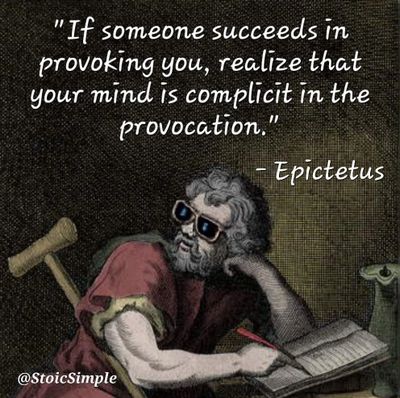
- Epictetus: A former slave whose teachings were recorded in the Enchiridion (Handbook).
- Seneca: A statesman and advisor known for his practical Letters from a Stoic.
Credit: https://blog.stoicsimple.com/epictetus-stoicism-quotes/